

LIVE Q&A with the Head Coach of Bates College Women’s Basketball, Alison Montgomery
We launched our live Q&A series with D3 coaches to make it easier for our readers to get their questions about school, sports, and admissions answered directly.
And it has already lead to our subscribers getting D3 college offers.
In this most recent episode, we were joined by the Head Coach Bates College women’s basketball head coach Alison Montgomery.
Watch Coach Montgomery’s full interview on our Youtube Channel.
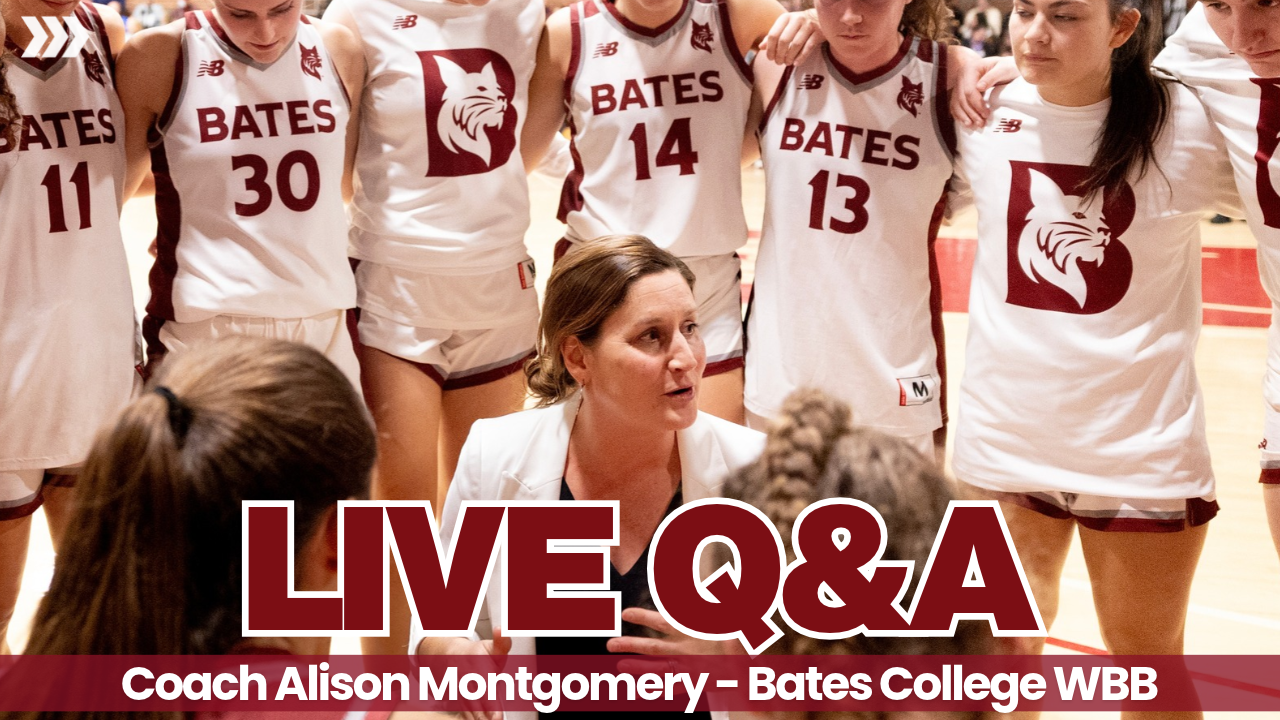
What Does a Top NESCAC Coach Want From Recruits?
Alison Montgomery, head coach of the Bates College women’s basketball team in Lewiston, Maine, says the best recruits make the process “incredibly two-way.”
That means personalized outreach, persistence, and independence from the athlete, and parents who are “the right amount engaged.” Last season her staff was named Conference Coaching Staff of the Year after a program-record 26 wins, four losses, and a Sweet 16 run.
Montgomery joined us for a live Q&A in our D3 head coach series, just before Bates opened its 2026-27 season. She played at Bowdoin, grew up in Maine, and is now in her 12th year at Bates.
What Does a Bates Coach Look for in a Recruit?
Montgomery says the basketball evaluation is the easier half. “It’s definitely an art and not a science,” she said. “You’re using your gut in a lot of ways and you’re trying to predict based on past success you’ve had.”
What helps a recruit stand out is engagement. “Something that’s just really important is just finding women that just are really engaged in the recruiting process,” she said, “and I think right away identify something unique about Bates and about our program.”
She wants both sides to be asking questions: “I really want that recruiting process to be incredibly two-way... I also want there to be a level of women recognizing what an opportunity it is that we might be presenting or recruiting them to.”
Need Help with your D3 Recruiting Process?
In order to determine if we can give you an assist, please complete our intake questionnaire and a member of our team will get back to you 🤝
How Should a Recruit Reach Out to a College Coach?
Make it personal. Montgomery described what a strong first message looks like:
“Something that feels personalized... something that feels like there’s something really specific about the reach out, whether it’s something specific about Bates. It could be the academic program. It could be the athletic program. It could be a mutual connection... That’s like 101 in terms of like, hey, let’s get to know each other.”
She also encourages persistence: “I definitely encourage recruits to be persistent... be really persistent about where you’ve identified you think would be a good fit for you.” She says her staff tries to reply to everyone, and that it helps when other people speak up for a recruit. “I do a lot of that reach out myself... to opposing coaches, to just people in their inner circle.”
What Role Should Parents Play in Recruiting?
Montgomery described this as “a really fine line.” She wants athletes to lead: “I want to recruit women who are driving the process... In a lot of cases, this is maybe the first big decision they’ve ever made. I want to feel like their love of basketball and their pursuit of this specific school is driven by them.”
At the same time, parents aren’t a turnoff. “I also know we need to be partners,” she said. “The way their parents are supporting them, the advice they’re giving them, it really matters to them.” Her summary: “I do want parents who are the right amount engaged, which I know that’s a really gray answer.”
She also pays attention to families as a whole. “I am all about recruiting families,” she said. “It’s a huge sacrifice, this phase, no matter how that pans out for families in terms of how much they’re paying or how much they’re traveling... So I want that experience to be really great for them too.”
What Does Montgomery Say to Her Team After a Win or a Loss?
Her goal is to say less. “It’s my goal every year, which I don’t think I’ve achieved yet, to say less after a game,” she said. “Once I’ve had 24 hours both to process and also to watch the film, there’s a lot that really shakes out for your perspective.”
Her routine in the locker room:
She stays quiet first. “When we first walk in the locker room at halftime and after the game, I don’t say anything. I give them the floor.”
She listens for who speaks. “Typically the women who are going to speak up first feel pretty confident in what they’ve observed... or it’s the captains or upperclassmen who I really trust.”
She checks her gut against the box score. “Thank God I have a box score before I walk in the locker room, because I’ll be like, I feel like we got crushed on the boards. And I’m like, oh, we were plus eight.”
She takes the pressure off the moment. Early in her career she felt she had to say all the right things right away. Now: “I’m going to see you all tomorrow... For now, shower up, go get something to eat, go do your homework, and I’ll see you tomorrow.”
Why “Joy” is a Team Value
Last season the team chose joy as one of its values. Montgomery said it came from the players, because the year before “we just expected to win so much that we were not celebrating the wins.” Her reaction: “Winning is hard. I don’t care who you’re playing.”
Her fix: “The first thing you say is like, LFG, we did it. We got it done and here’s how we did it... Let’s not lose that joy and let’s also celebrate it when we get in that win column.”
How Do Bates Players Set Goals?
Players lead. “It’s definitely player-led,” Montgomery said. “I want their vision to fully come from them... It has to really resonate with them.”
The harder part, she said, is the follow-through: “It’s a really sort of arduous process every season to then not set your intention, but to be accountable to your intentions every day. Man, that is a grind. I think that’s kind of what sets apart the good from the great.”
This year’s theme is “raising the bar.” She also shared a line from a current player she loves: “This is not a team, this is a program.”
What Montgomery Wants Players to Gain Over Four Years
She recruits with the end point in mind. “I’m recruiting someone as a 17-year-old, but I see them in that moment of who I believe they can be when they’re 22,” she said. “Having a vision for them is really, really important and going all in on them.”
On what changes over four years, she says Division III’s limits on offseason contact shape the answer: “As a Division III coach, we don’t have time to work with them in the off season... They do make these incremental improvements in their skill. But really to me, it’s about the way they’re thinking about themselves and just going as all in in themselves as I am on them.”
Montgomery’s Own D3 Playing Career
Montgomery was a four-year starter at Bowdoin. According to the host’s introduction, her teams won four NESCAC championships, compiled a 108-9 record, made four NCAA tournaments, and reached the national title game. She was a captain and a two-time NESCAC all-academic selection.
She says one of her biggest lessons came from trying something outside basketball. In the middle of her junior season, she auditioned for a campus play on a whim and was cast. Her coach didn’t say no. “She was incredible,” Montgomery said. “She was just kind of like, all right, let’s figure it out. Let’s line up your schedules.” But the coach also set expectations: “If you want to do this, you need to figure out where you’re going to find time to sleep, when you’re going to find time to eat. And if you do this play, you better do it well.”
Her team hosted the NESCAC tournament that same weekend, and Montgomery performed Thursday through Saturday nights. They won the championship on Sunday. “It just stretched me and it taught me a lot about what I was capable of,” she said. “If I really wanted to do something and it was important to me, I gotta go figure out how to do it and do it well.”
Why Did She Come Back to Maine?
When she left high school, her only criteria was “I’m leaving Maine,” but the school that resonated most was in Maine. After coaching elsewhere and moving up a level, she returned. “There’s such a sense of community here,” she said, “especially around high school athletics, women’s basketball for sure.” Part of why she recruits in-state: “I’m also really motivated to try to keep some of our best players in state and to really get to experience that community play in front of that community.”
How Does Bates Handle the NESCAC’s Later Start Date?
Montgomery said the NESCAC doesn’t get the extra fall practice days that many other conferences have. “We in the NESCAC, we are the last men and women standing up here. We don’t get extra days or hours with our program. So we are still tied to that starting date of the 22nd of October.” She sees an upside: “It allows our women to be really motivated and run a lot of that stuff on their own.”
What Is Bates Basketball Focused on This Season?
Bates graduated three starters, including 6’4” center Elsa Daulerio, “a centerpiece of our offense.” Montgomery isn’t worried. “We have all the pieces. We have all the talent,” she said, “but also just our leaders and the mindset that our women have.”
She pointed to a precedent from five years ago, when All-American Megan Graff, the program’s all-time leading scorer, graduated. “There was a lot of questions around who is going to shoot the ball... And we had an outstanding year. Went to the championship, went to the Sweet 16, because those women just believed in their identity that year, and women stepped into roles.”
Frequently Asked Questions
What do D3 women’s basketball coaches look for in recruits? Head coach Alison Montgomery says it’s a two-way process. She looks for recruits who are engaged, who can name something specific about Bates, and who drive the process themselves.
How should a recruit email a D3 coach? Make it personal. Coach Montgomery recommends mentioning something specific, such as an academic program, the athletic program, or a mutual connection, and following up with persistence.
Do D3 coaches want parents involved in recruiting? Montgomery wants athletes to lead the process but says parents’ support matters - Parents who are “the right amount engaged.”
Does Bates women’s basketball compete in the NESCAC? Yes. One thing to know: The NESCAC has a slightly later practice start date (October 22) than many other D3 conferences.
What was Bates women’s basketball’s record last season? Bates went 26-4, a program record for wins, and reached the NCAA Sweet 16. Montgomery’s staff was named Conference Coaching Staff of the Year.
Thinking About Playing D3 Basketball?
Montgomery’s advice comes down to a few habits: personalize your outreach, stay persistent, drive the process yourself, and involve your family in the right way.
D3Direct helps high school athletes and their families navigate NCAA Division III recruiting, admissions, and financial aid.