

From Linfield Baseball to World Series MVP: What Scott Brosius Learned About Trusting the Process
Listen to Scott’s episode of the Student Athlete Sessions (Link) or Watch on Youtube (Link)
If you grew up watching baseball in the 1990s, you know Scott Brosius as the third baseman who helped the New York Yankees win three consecutive World Series titles, and whose iconic 1998 World Series MVP performance is one of the great underdog stories in baseball history. What you might not know is that his path to the Bronx Bombers began at a small liberal arts D3 school in McMinnville, Oregon, that most Division I recruiters had never heard of.
Brosius joined our Student Athlete Sessions podcast to talk about his recruiting journey, his professional career, and what brought him full circle back to Linfield University, where he now serves as Athletic Director. The conversation is packed with lessons for any student-athlete navigating the recruiting process, especially those frustrated that the big schools aren't calling.
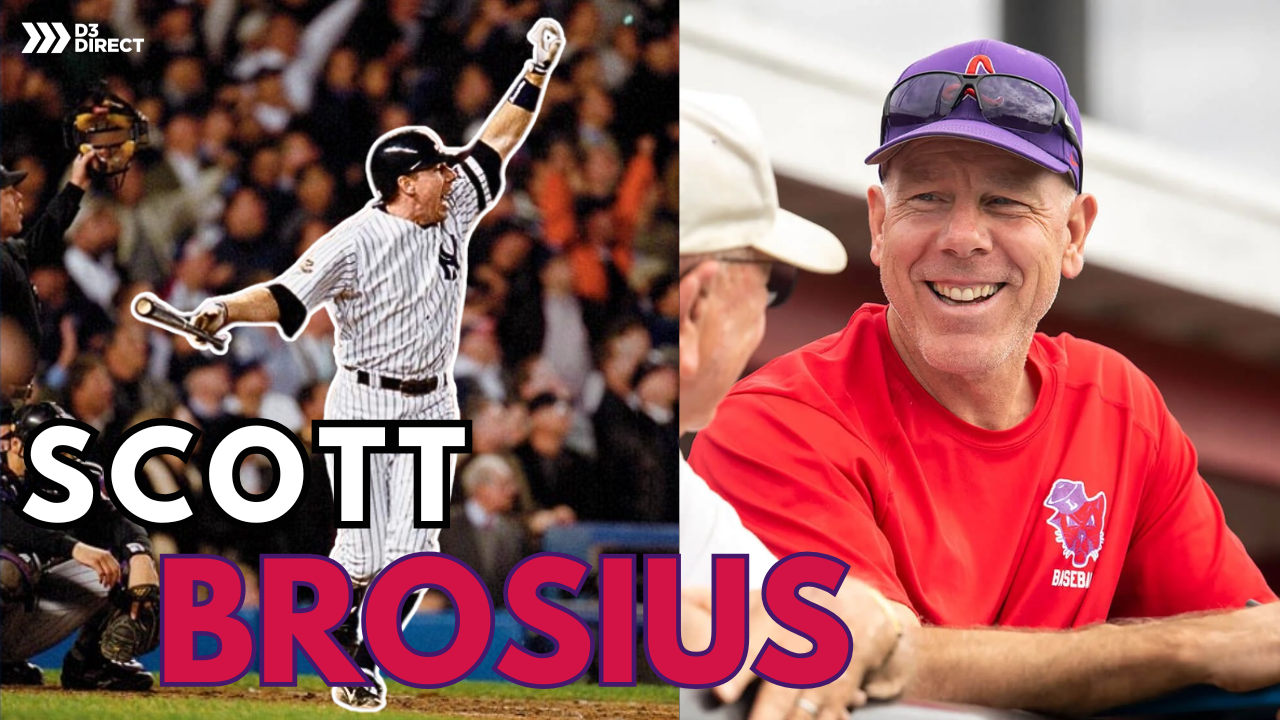
"I Was 6 Foot, Weighed 165 Pounds, and Was Shaving Only to Say That I Could Shave"
Brosius was candid about where he stood coming out of high school. Stanford was the dream. Oregon State, Portland State or any Division I baseball program would have done. But the phone wasn't ringing the way he hoped.
"Physically, I was behind some others," he said. "Didn't really have those schools beating down my doors."
His last real audition for a bigger program came at the State Metro Game, an all-star showcase that turned into something of a disaster. He went 0-for-3 with two strikeouts as a hitter, hit into a double play the one time he made contact, and didn't even last an inning on the mound, leaving with the bases loaded and a couple of earned runs.
That bad game, it turned out, may have been exactly what Linfield Baseball Head Coach Scott Carnahan needed to see. Brosius laughed recalling the conversation years later: "He goes, 'I was just smiling the whole time, because I knew it helped my chances to get you here at Linfield.'"
It's a reminder that coaches aren't always watching for highlight-reel moments. "I absolutely wanted to see guys have a bad game," Brosius said of his own time recruiting D3 athletes to Linfield. "I want to see how they handle success, but I also want to see how they handle the failure, and how they carry themselves, and how they respond."
The Coach Who Didn't Laugh
When Brosius arrived at Linfield as a 165-pound freshman, Carnahan sat down with him and asked a simple question: What are your goals?
Brosius told him he wanted to play professional baseball.
"He didn't laugh at me, he didn't give me the odds against this or anything like that. He just said, 'Listen, all the work is hard for you as you're willing to work for yourself and for the program, and we'll see if we can make this happen.'"
That moment stuck with Brosius for the rest of his career. Carnahan went on to actively contact scouts as Brosius developed, becoming a key bridge between a small NAIA baseball program (Linfield switched to D3 in 1995) and the professional game. Brosius's message to any recruit listening: Share your goals out loud.
"We have to make them tangible," he said. "Because anybody can just sort of say, I want to win a championship. But do you really believe it's possible? And then, if you believe it's possible, are you willing to take the steps to go out there and make that happen?"
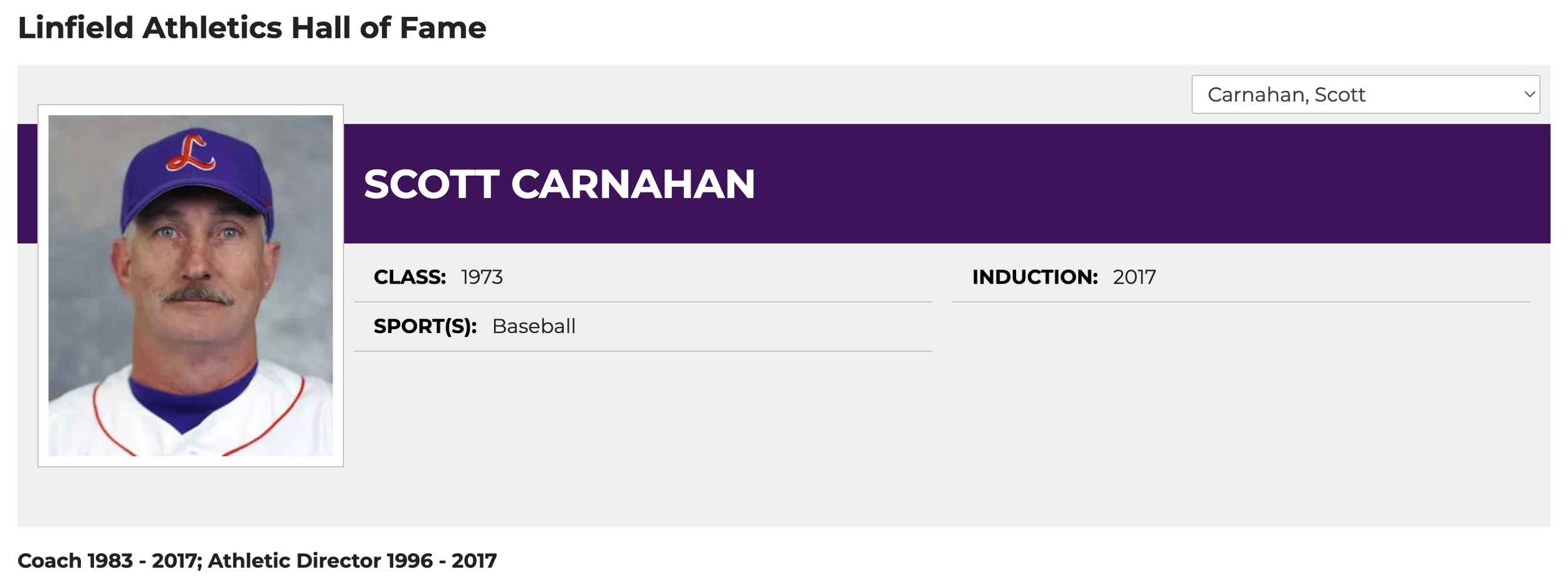
Scott Carnahan was Scott’s baseball coach at Linfield (Photo via Linfield Athletics)
Three Years at Linfield, a Draft, and a Lesson About Growing Up First
Brosius was drafted by the Oakland Athletics in 1987, but almost went higher. He admitted he fumbled the ‘signability’ question scouts kept asking, hedging about maybe wanting to stay in school to continue his degree when he should have just said yes he was ready to play pro baseball. As a result, he slid from a potential 11th-round pick to the 20th round of the MLB Draft.
But looking back, he's grateful he went to college at all. Linfield University gave him something no minor league organization could: Time to grow up.
"I was so glad I was not drafted out of high school," he said. "I matured so much at Linfield — not just physically. I mean, certainly on the field, I got stronger, put on about 20 pounds. But more importantly, just emotionally, matured as well. I found myself, being away from home, on a campus, living on your own... it's that step towards preparing yourself for really a lot of ups and downs in baseball."
He added something that every athlete who's ever had a rough stretch can relate to: "Baseball is a game based on failure. As a hitter, the best hitters fail 7 out of 10 times. And so, how do you deal with the ups and the downs? I certainly learned that at Linfield."
The Worst Year, Then the Yankees
By the mid-1990s, Brosius had worked his way into an everyday role with Oakland. Then 1997 happened.
Injuries. A knee surgery he rushed back from three weeks later. A performance spiral he couldn't pull himself out of. He stayed in the team’s batting cages until midnight trying to fix his swing. Nothing worked.
"I beat myself up a lot," he said. "Sometimes the harder I try, the worse it gets kind of thing... I was just beating myself up physically and mentally."
That offseason brought some soul-searching, and a commitment. "I made a commitment that, listen, you're in the big leagues, and you're doing what you've wanted to do your entire career. You've got to allow yourself to enjoy this through the ups and the downs."
Then he got traded to the New York Yankees.
"It was just a shot of adrenaline to my career," he said. "Going from an environment at Oakland, 8,000 people at a game, and a team that at that point was just a rebuild team... to 40,000, 50,000 in Yankee Stadium, and a chance to be in the playoffs."
What the Yankees Taught Him About Team-First Culture
Walking into the Yankees clubhouse in 1998, one thing was immediately clear to Brosius: No one talked about individual stats.
"All they talked about, every guy — whether it's Tino Martinez, Paul O'Neill, Derek Jeter, Bernie Williams — all they talked about was, 'We're going to the World Series, we're getting back to the World Series.' It was all about team and having success there."
He took that lesson to heart, both on the field and in how he tuned out distraction. Playing in New York meant a relentless media cycle, and Brosius made a deliberate choice to ignore all of it.
"I didn't want to know what reporters were writing about me, good or bad. I didn't want to see it... I wanted to kind of just quiet the noise."
He quoted a piece of wisdom from Mark McGwire, his former Oakland teammate, that has stayed with him ever since: "You're never as good as you think you are, and you're never as bad as you think you are. You're always one swing away from turning it around."
His advice for athletes today drowning in social media noise: "We gotta just decide whose voices are important to us. Are we going to let all this chatter from people we've never met, we'll never will meet — are we gonna allow that chatter to impact how we think?"
He also had a KISS written on his glove. Keep It Simple, Stupid.
"The ball's hit to you — what's your job? Catch it. Then what? Throw it. You know, all the other stuff doesn't really matter. Ultimately, that's your job."
Coming Home
After retiring in 2001 as a World Series MVP and three-time MLB champion, Brosius went back to Linfield to finish his degree. Not because he had to. Because it mattered.
"I wanted to show my kids the importance of education as well. That even though I didn't technically need to go back, I felt it was important enough — that we thought education was important."
He eventually returned to coach baseball at Linfield in 2007, going 270-96 and winning a national championship. The full-circle story with Carnahan got even fuller: Carnahan had stepped back from coaching to become the school's AD and assistant baseball coach. Which meant that now his former player was his boss on the diamond — and technically, each man could fire the other.
Brosius's oldest daughter saw the humor in it: "You and Carney are gonna have to get along, because technically you can fire him, and then he could fire you."
Now Brosius holds the AD role himself at Linfield, and he's clear about what he's building. Nearly half of Linfield's undergraduate students are D3 athletes. He wants to make sure every one of them is supported, not just on the field, but in strength and conditioning, nutrition, and mental health.
"I do believe that athletics is a classroom outside the classroom," he said. "And if you're gonna offer anything, if you're gonna commit to something, let's see how good we can become."
The Advice He'd Give His 18-Year-Old Self
When asked what he'd tell a younger version of himself, Brosius’ answer wasn't about mechanics or draft strategy.
"I would just tell myself to trust myself more. You put in the work, you're putting in the time, you're doing all that — now just go out and trust your ability. Don't stress so much about it."
For the tinkerers out there, the athletes who are constantly adjusting, optimizing, trying to find the one more thing that will unlock their game, Brosius had one more thought:
"Sometimes when we can just turn off the brain and compete, right? Cages are where we work on something. At the plate is where you compete. You just go take an at-bat."
Scott Brosius is the Athletic Director at Linfield University in McMinnville, Oregon. Listen to his full conversation on D3Direct’s Student Athlete Sessions on Spotify, Apple Podcasts, or wherever you listen.