

Umar Rashid: From D3 Basketball to Playing Professionally Overseas
Umar Rashid, a 6'6" forward from Canton, Georgia, was discovered by Case Western Reserve through a Twitter DM, earned a computer science degree while playing D3 basketball, and is now in his second pro season in Spain after a rookie year in Ireland. He also played for the Guyana national team in FIBA AmeriCup qualifying.
Rashid's path covers most of the questions D3 recruits and their families ask: how to get noticed with no big-name offers, how to choose a school when you can't visit, how to balance basketball with a demanding major, and how to find an agent and land a pro contract. He shared it all on his episode of the Student Athlete Sessions podcast.
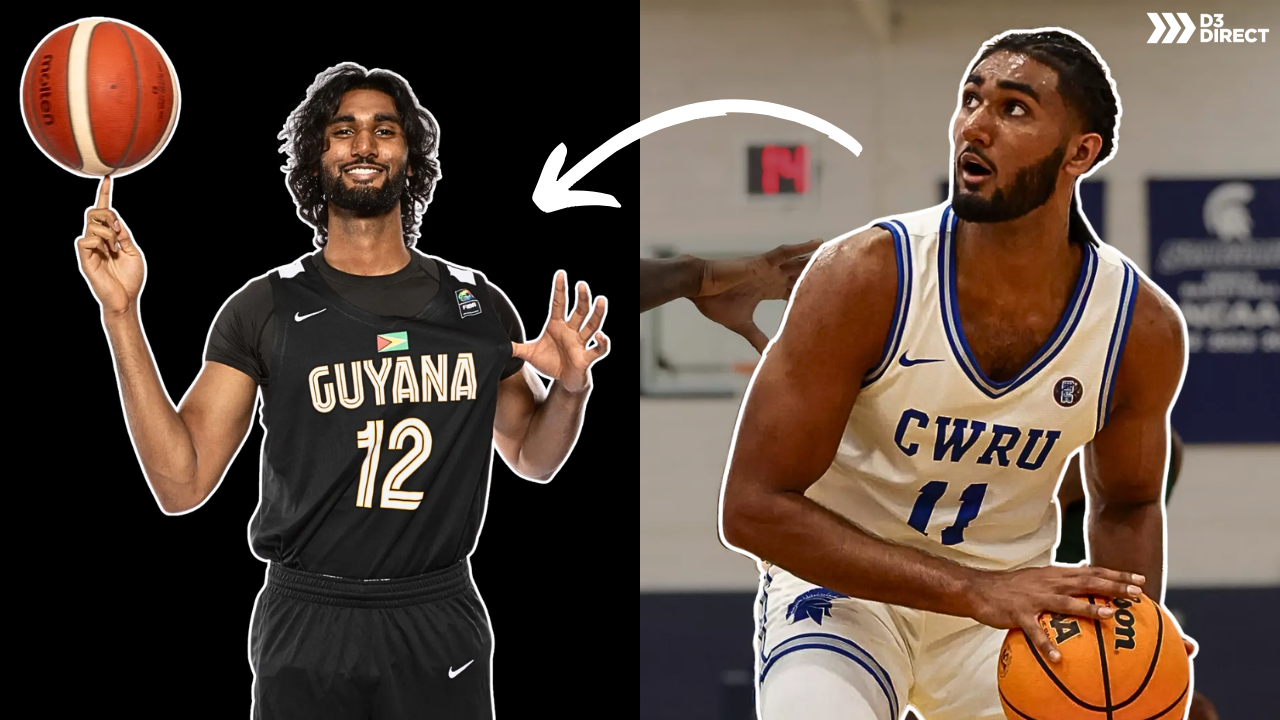
Umar Rashid went from D3 basketball to playing professionally overseas and representing Guyana’s national team.
How Did Umar Get Recruited to Case Western?
Rashid was in the high school class of 2021, which meant a recruiting process with no summer live periods, no campus visits, and few coaches able to watch players in person. Despite having an impressive high school career where he averaged 18 points, 10 rebounds and 2 blocks per game, he received no early interest from college coaches.
What changed things was a post on social media. A notable account started a thread asking class of 2021 recruits to drop their highlights and metrics. Rashid replied with his height (6'6"), GPA (4.5), test scores, wingspan, and film. An assistant coach at Case Western saw it and sent him a DM, and a Brandeis assistant reached out soon after. He had never heard of Case Western before that message, but his recruiting process was off to the races.
The takeaway for recruits: Free platforms work when your information is organized. Rashid says to post your highlights and stats consistently, tag coaches, trainers, and local journalists who cover your area, and make it easy for a busy coach to evaluate you in seconds.
D3Direct Note: Recruits should be platform agnostic. That means publishing your film on Twitter, Instagram, YouTube, Hudl, or other places where coaches are looking so it can be easily found.
Getting Rejected from MIT & D3 Admissions Support
Case Western wasn't Rashid's first choice.
He applied early action, was deferred to regular decision because of a missing piece of his application, and nearly didn't apply again because he didn't want to live in Cleveland. He was looking at other top-ranked academic schools like WashU, UChicago, Caltech, and Pomona-Pitzer, and he actually committed to play at MIT in January of his Senior year.
However, he didn't get into MIT. Because he had committed there, he had told other schools they weren't his choice. As a result, those programs had used their admissions support on other recruits who were admitted so his previous offers were no longer on the table. Ultimately, Rashid went back to the staff at Case Western and they welcomed him to Ohio.
Two lessons stand out from his recruiting experience:
A D3 commitment does NOT guarantee admission. If you don't get into a D3 school, you can't play there. Admissions support from the coach matters, but it doesn’t mean that you will automatically be admitted. It is important to remember that committing to one school means other programs will likely move on.
Rankings aren't everything. Rashid says Case Western turned out to be "the biggest blessing in disguise." After four years there, he says Cleveland feels like home. Visiting a campus and meeting the team can change how a school looks on paper. Umar wasn’t able to do this because he was recruiting during COVID lockdown, but make sure to take advantage of this is your own process.
Can You Play Basketball and Major in Computer Science at a Rigorous D3 School?
Rashid declared computer science early and says balancing it with basketball at Case Western was tough, but doable.
Here’s what he did to make it work:
Academics come first in D3. If you have lecture or exams, you go. Basketball is supposed to come second, and coaches plan around that. But this requires that athletes take a lot of ownership, letting both coaches and professors know well in advance where there might be a conflict.
Find help in your major. An older teammate who was also a computer science major helped him early on. This is a great reminder to ask for help where you need it. Most academic programs will have upperclassmen willing to tutor younger students. This isn’t like D1 where they’ll basically do your work for you, but rather real guidance to help you master a topic.
Build a life outside the gym. Rashid didn't want to be known only as "the basketball guy." He made friends through his major and through campus groups connected to his cultural and religious background, including the Pakistani Students Association and the Muslim Students Association. Expand your horizons and always think of yourself as more than just an athlete.
His advice applies to any hobby, from film to chess to video games: join a group outside your team. It gives you a break from basketball and helps with the stress of road trips and heavy course loads.
Why Playing Defense Gets You on the Court
Rashid is 6'6" with a seven-foot wingspan, and he says defense is what kept him on the floor in college and what he leans on as a pro playing overseas basketball.
His reasoning: "You're going to be able to play at the level that you can defend at."
A neutral defender can get on the floor, he explains, but a positive defender earns a coach's trust, and trust brings freedom on offense. His mindset in his first years at Case Western was to make athletic plays and keep the game simple. "A coach can look down the bench and be like, okay, we can trust him out there."
Dual Citizenship: The Overseas Advantage Many Recruits Miss
Rashid's father is from Pakistan and his mother is from Guyana. He began applying for a Guyanese passport in March 2025, and after a long process he received it in June 2026.
Why it matters for pro basketball: most overseas leagues limit how many American imports a team can sign. Holding a second passport means you can be a different kind of import. "There's tougher limits on being an American in most leagues because American talent is so good."
The passport also opened another door. Within days of getting it, his agent connected him with Guyana's new national team coach, and Rashid tried out for the team's one spot for a player not born in the country. After roughly two weeks of practice, he made the roster and played four FIBA AmeriCup qualifying games in Guyana against teams including Bermuda and Antigua and Barbuda. It was his first trip to Guyana, and his mother came to every game, her first time back in her home country in almost 40 years.
How to Find a Pro Basketball Agent as a Division III Player
Rashid started the process the summer before his senior year of college by asking former teammates, trainers, and his head coach for connections. After the season he stepped it up and signed with an agent around late April or early May.
The introduction came through a former teammate who had played at Mercer, who connected him with three agents. Rashid messaged several, but only one stayed consistent. His reasoning mirrors his recruiting advice: "I'd be stupid not to go where I'm wanted."
He applies the same rule to evaluating pro contracts. In Ireland and now in Spain, he says the coaches and club leaders made it clear they wanted him before he signed, and that made for a better experience. For high school recruits, he says to look for genuine interest from a coach, not just a sales pitch, and not to take it for granted.
Life as a First- and Second-Year Pro Overseas
Rashid played his rookie season in Ireland and is now in Huelva, Spain, in a lower division where the local basketball culture is strong and the pace is faster than anywhere he has played. In his first two games he posted 17 points and 12 rebounds, then 10 points and 7 rebounds, respectively.
What he says is hardest:
Loneliness was the biggest adjustment in Ireland. Having done it once, being away from family bothers him less in Spain.
Language is the biggest challenge in Spain. He had some Spanish coming in and is documenting his progress on social media.
Off the court, he worked a part-time contract job for a startup in Ireland and is now working with a former Case Western teammate on a basketball-related app. He is also gearing his content toward mentoring younger players.
His team's goal this season is to win its conference and earn promotion to the next league. His personal goal is to show he can play at a higher level: a three-level scorer, a knockdown shooter, and a defender who can guard multiple positions.
Advice to His 18-Year-Old Self
Asked what he'd tell his younger self, Rashid said: "Put in everything that you can."
At 18, he says, he didn't realize you could go from Division III to a pro career, or even get a chance at the NBA. Looking back, he wishes he had put in more time and effort in college. "This game can carry you so far, this game can open so many doors, but if you put in that genuine hard work, that's the only way you're going to see those benefits."
Frequently Asked Questions
Can you play professional basketball after Division III? Yes. Umar Rashid played at Case Western Reserve University (D3) and is now in his second pro season, after a rookie year in Ireland and a current season in Spain.
How do you get recruited by a D3 school if you have no offers? Create a highlight reel and a clear information sheet with your height, GPA, test scores, and wingspan, then share it publicly and tag coaches. Rashid was discovered when a Case Western assistant coach saw his reply to a class-of-2021 recruiting thread on Twitter.
Why does admissions support matter in D3 recruiting? D3 schools can't offer athletic scholarships, and a coach's support in admissions is often what makes a spot on the roster possible. If you commit to one school and aren't admitted, you can't play there, and other programs may have moved on to other recruits.
How does dual citizenship help overseas basketball players? Many leagues cap the number of American imports per team. A second passport can let a player compete for roster spots as a domestic or non-American player, and it can also open the door to national team opportunities.
How do you find a basketball agent to play overseas? Ask former teammates, trainers, and coaches for introductions. Rashid reached out to multiple agents and signed with the one who communicated consistently and clearly wanted to work with him.
Can D3 athletes handle rigorous majors like computer science? Yes. D3 programs generally prioritize academics, and athletes are expected to put class and exams first. Building study relationships with classmates in your major helps.
Thinking About Playing at the D3 Level?
Rashid's story shows that the D3 path can lead to a strong degree, a college community, and, for some athletes, a professional career. Getting there takes organized recruiting, honest communication with coaches, and a clear view of admissions.
D3Direct helps high school athletes and their families navigate NCAA Division III recruiting, admissions, and financial aid. Learn more at d3-direct.com