

D3 Women's Basketball Recruiting Reality - A Coach's Honest Take
D3 women's basketball coach and WBCA Assistant Coach of the Year Elsebeth Birman breaks down D3 sports recruiting, Division II vs Division III scholarships, and what coaches look for in female athlete recruits.
Listen to Elsebeth’s episode of the Student Athlete Sessions (Apple) (Spotify)
Most recruiting advice comes from people who've seen the process from one side. Elsebeth Birman has seen it from three: As a high school athlete who had no idea what she was doing, as a Division II college player who worked under three different coaching staffs, and as a Division III assistant coach, and now Director of Player Development, who spent years on the other side of the recruiting table at Shenandoah University in Virginia.
Birman recently joined D3Direct's Student Athlete Sessions podcast to talk about her path through college basketball, what D3 and D2 recruiting actually look like from a coach's perspective, the real difference between athletic and academic scholarships, and the organization she founded — Hoops Through Life — that is changing how coaches work with female athletes.
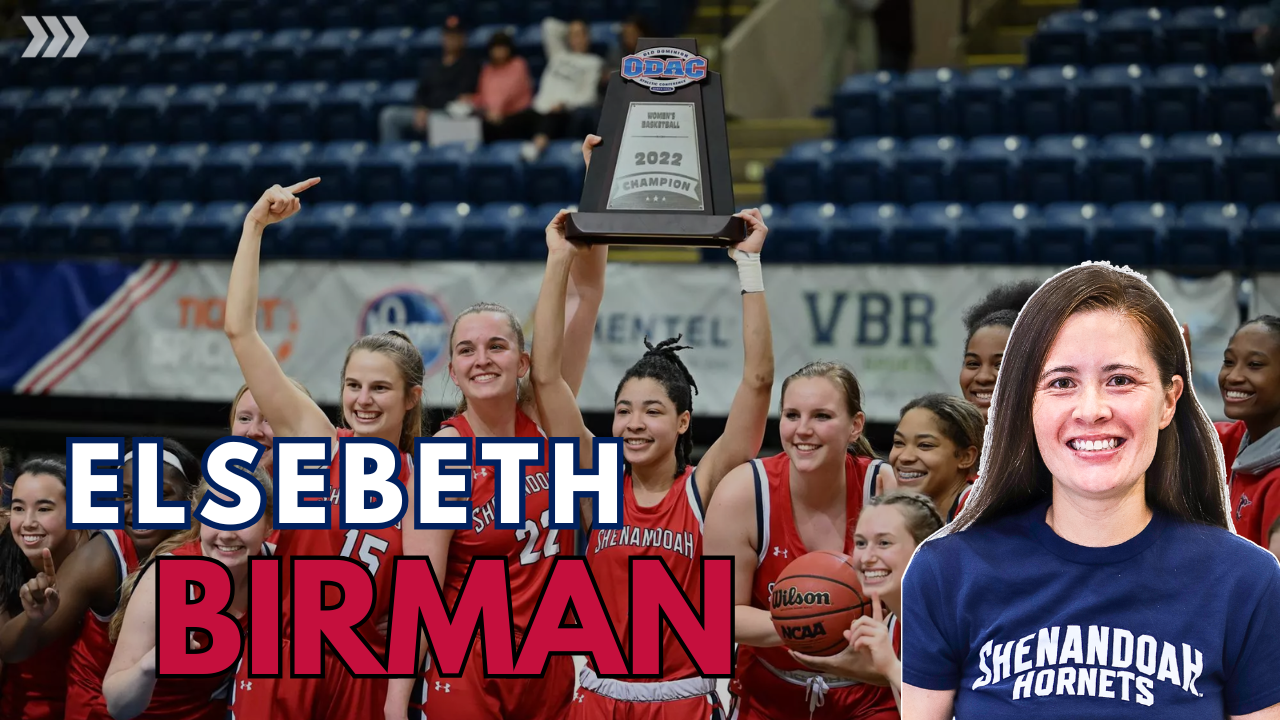
Director of Player Development with Shenandoah Women’s Basketball, Elsebeth Birman
Growing Up at a Basketball Powerhouse — and Learning What That Meant
Birman grew up in Silver Spring, Maryland and attended St. John's High School, one of the most decorated girls basketball programs in the region. The most notable alum in recent years is Azzi Fudd, now a number one overall draft pick playing in the WNBA. When Birman was coming up, the name was Marissa Coleman, who went on to the University of Maryland and the Washington Mystics.
That context — being surrounded by WNBA-bound talent — is both motivating and clarifying. For Birman, it forced an early honest reckoning.
"[At St. John’s], you hear all of these really high-caliber Division I schools," she said, "and that wasn't going to be me. That wasn't going to be my path."
She played AAU with a coach who, she says, didn't care about level. "It was just, hey, let's use basketball as a tool to get you to the next level." That framing stuck. By 8th or 9th grade, she knew she wanted to play in college. The question was where — and she didn't have a great process for figuring that out.
"I really had no idea what was going on," she said. "I relied heavily on that one AAU coach."
It's a dynamic she would recognize immediately years later when she started recruiting for Shenandoah. "You can tell when [recruits are] really just confused about the process," she said. "Some of those conversations, we weren't really talking about Shenandoah as much — it was more, hey, this is what I'm hearing, and this is what I think might be helpful for you.
Replace Guesswork with a Game Plan
Stuck in your recruiting process? Get the D3 Recruiting Playbook today! Learn more

The D3 Recruiting Playbook
How Division II (D2) Scholarships Actually Work (And Why It's More Complicated Than You Think)
Birman committed late in her senior year, well after the season ended and later than most of her peers. She played her first two years at the University of Bridgeport in Connecticut before transferring to the University of the Sciences in Pennsylvania, where she finished her career. In four years, she had three different coaches.
That experience gave her an unusually granular look at how Division II scholarship money actually works, something most recruits and families badly misunderstand.
"If you think about, like, a pot," she said, "there's a pot of money, and you can… the coach has discretion to dole out that pot of money however they feel like they want to."
Her first coach at Bridgeport told every incoming player exactly what they'd receive and how it would increase each year — transparent, consistent, predictable. Her second coach took a different approach: she looked at Birman's existing package and bumped it up because she felt it was too low given that Birman was starting. By the time she transferred to the University of the Sciences, the structure went back to the everyone-gets-roughly-the-same model.
The lesson for recruits: A D2 athletic scholarship is rarely a full ride, and it can look very different depending on the coach, the program, and the moment you arrive.
"It's not always the same depending on where you play," she said.
There's another variable most recruits overlook. Birman came in with strong academic credentials, and that mattered to coaches in ways she didn't initially expect.
"Because I came in with such a good GPA, it was more attractive to those coaches, because they wouldn't have to spend as much on me," she said. "I was already coming in getting a pretty high amount of academic aid. So that also made them more excited for me."
At the Division III level — where there are no athletic scholarships at all — this dynamic becomes even more pronounced. Strong academic profiles unlock institutional merit aid that can dramatically reduce the real cost of attendance, and D3 coaches actively advocate for their recruits with financial aid offices.
What D3 Coaches Are Actually Looking for in Female Athlete Recruits
When Birman joined Shenandoah's staff, the program's record wasn't strong. The coaching staff made a deliberate decision: Recruit for academic profile first.
"We decided we were gonna put all of the effort into getting what we deemed as really good academic students," she said. "Students that could be self-motivated, or were knowing what they wanted to study and they were committed to their academics."
The theory was that academic discipline would translate to every other area of the program. It worked.
"Our belief was, you focus on this, and it'll expand to other areas. And luckily for us, that helped, and that was a good tactic."
Over time, the academic identity of the program became a recruiting asset in itself. When recruits look at Shenandoah's roster and see health professions, nursing, and rigorous majors represented, it sends a signal: You can do that here and play basketball.
"A lot of times, we'll get athletes who are interested in nursing, and they say, well, you know, this school said I can't do nursing and play basketball. And it's like, you can kind of do that here."
That's not unique to Shenandoah. It's a feature of the Division III (D3) model — professors, coaches, and athletic departments working together to accommodate demanding academic paths. Shenandoah ran 9 to 11 p.m. practices this past season because class schedules ran late into the day.
"We're committed to the academics part of it," Birman said. "Sometimes what takes a hit is the social a little bit, especially during season, but we try to make up for that in different ways."
The WBCA Award She Almost Thought Was Spam
In 2021, Birman received a text from an unfamiliar number. The sender identified herself as the president of the Women's Basketball Coaches Association. Birman's first instinct was skepticism.
"I was like, is this spam? Like, you get a lot of spam texts. So I ended up looking the phone number up, and I was like, no, this seems legit."
It was. She had been named the WBCA Division III Assistant Coach of the Year — selected out of more than 400 programs nationally. Her head coach had nominated her without telling her.
Her first thought upon hearing the news wasn't about herself.
"I thought about the players. That was the first thing I thought about — man, how lucky am I? Because they make it easy. They make it easy to be a fun and good coach and to connect with them."
The in-person ceremony was replaced with a virtual celebration due to COVID, but the recognition stuck. It's the kind of acknowledgment that's easy to overlook from the outside — Division III isn't covered the way Power Five basketball is — but it represents the highest honor in the coaching category for the largest division in NCAA basketball.
Hoops Through Life: Building a Better Framework for Female Athletes
Birman's work extends well beyond the Shenandoah gym. She founded Hoops Through Life, an organization focused on helping female athletes navigate the challenges of competitive sports, build confidence, and develop skills that carry beyond playing eligibility.
The origin was her graduate work in occupational therapy. Her master's research focused on athlete transition. Specifically, what happens when athletes move into or out of their sport and what the data says about where support systems break down.
"I did a bunch of research, and I wrote a paper, and I presented on a couple things, and there were a few areas that stood out to me as just like, wow, we need to pay attention to these things."
She put that research to work through individual training sessions, team and group work, and girls' basketball camps (ages 6 to 15, based in the Virginia area).
The organization is now evolving in an interesting direction. Birman is shifting some of her focus toward supporting coaches themselves — specifically, helping them coach with neurodiversity in mind.
"The name that came up was just, like, every brain on the team," she said. "Coming at coaching with neurodiversity in mind."
The insight behind it: When a player consistently struggles to pick up concepts, the default coaching response is often to blame the player. But the question Birman started asking was different.
"Are they not gonna get it, or do we not know how to teach it effectively? Those are two very different ways to look at the same problem."
She's heard coaches say things like "you just can't teach that" or "they're never gonna get it" — phrases that, in her view, close off possibilities rather than open them. Her work with coaches is designed to expand the toolkit: more ways to communicate, more frameworks for reaching players who process information differently, more patience for the fact that not every athlete learns the same way in the same environment.
There's no formalized education for coaches in this area in the United States, she notes. Most coaches coach the way they were coached — or deliberately do the opposite if they hated their own experience. Hoops Through Life is trying to build something more systematic.
"I didn't know if any coaches would be into it," she said. "But I've gotten some really good feedback, and people seem to be very open to — I don't know how to connect with this player, this player never seems to understand what I'm saying, and they're willing to try different things."
What She'd Tell Her 17-Year-Old Self
When asked what advice she'd give her younger self, Birman didn't hesitate: "Just put yourself out there more."
In recruiting, that meant being more proactive — not relying on one AAU coach's network and assuming the right opportunity would find her. In college, it meant engaging more fully with campus life rather than staying in her shell.
"Once I got onto campus, I would just kind of put myself out there a little bit more. I was pretty shy, so I didn't really engage with as many things as I wish I did."
For the recruit reading this or listening to the podcast: The recruiting process rewards the athletes who initiate. Coaches at the Division III level — especially in women's basketball — are looking for athletes who have done their research, who reach out directly, and who show genuine interest in the program as a whole, not just the sport. Birman's experience on both sides of that conversation makes the point clearly.
And for the athlete already on campus: The opportunities in Division III go far beyond the gym, court or field. The ones who get the most out of it aren't necessarily the best players. They're the ones who show up.
Key Takeaways for Female Athletes Considering D3 Basketball
On the recruiting process: Start reaching out early and don't rely on one person's network to create your opportunities. Coaches notice athletes who are organized, proactive, and genuinely curious about their program.
On academic profile: A strong GPA is a recruiting asset, not just a ticket to merit aid. At both the Division II and Division III levels, coaches value academically motivated athletes — and financial aid offices respond to those profiles.
On Division II scholarships: Athletic money in D2 is rarely a full ride. It's distributed from a pool at the coach's discretion, it varies by coaching staff, and it can change when coaches change. Always understand what you're actually receiving, not just that you "have a scholarship."
On the D3 choice: The level of competitive commitment isn't different from D2. The flexibility — particularly around demanding academic majors — is often greater. The financial picture, when academic merit aid is stacked correctly, can be surprisingly comparable.
Elsebeth Birman is the Director of Player Development at Shenandoah University and the founder of Hoops Through Life. The Hoops Through Life podcast features conversations with college coaches about what they look for in recruits — essential listening for any female athlete in the D3 recruiting process. Reach Elsebeth at hoopsthroughlife@gmail.com or through the contact form at hoopsthroughlife.com. Listen to the full Student Athlete Sessions episode on Spotify, Apple Podcasts, or wherever you get your podcasts.