

Stop Ruling Out D3 Schools Because of the Sticker Price
What the average student actually pays at the nine most expensive D3 schools (All $100k plus in sticker price)
Welcome Back, and thanks for trusting D3Direct to help you with your recruiting process!
In this post we’re talking D3 Tuition Sticker Prices and why you should never rule a school out just because their cost of attendance looks expensive on paper.
Our focus, nine D3 schools with $100,000 annual tuition.
Not a subscriber yet? Join free today!
Check out this recent episode of the Student Athlete Sessions to hear from Linfield Volleyball Head Coach Jenna Street. She was a former D3 Athlete at Cal Lutheran and now leads the Wildcats, playing in the Northwest Conference.
Read the full article on Jenna’s career as both a college athlete and now college coach (Full Article)
Do All Division III Athletes Really Pay $100,000 a Year? What the Sticker Price Doesn’t Tell You
Quick answer: No.
While 9 of the 15 most expensive colleges in America for 2026-27 are Division III schools with sticker prices over $100,000, the average need-based financial aid package at these schools cuts the real cost to somewhere between $25,000 and $45,000 a year.
Families who assume D3 means “no athletic scholarships, so full price” are working from the wrong number.
Let’s break it down…
Why are so many D3 schools on the list of most expensive colleges?
Of the 15 schools with total costs exceeding $100,000 for the 2026-27 academic year (per The Princeton Review, via CNBC), nine are Division III institutions:
Harvey Mudd College (CA) - HMC Financial Aid
University of Chicago (IL) - UChicago Financial Aid
Washington University in St. Louis (MO) - Washu Financial Aid
Smith College (MA) - Smith College Financial Aid
Claremont McKenna College (CA) - CMC Financial Aid
Vassar College (NY) - Vassar Financial Aid
Wesleyan University (CT) - Wesleyan Financial Aid
New York University (NYU) - NYU Financial Aid
Haverford College (PA) - Haverford Financial Aid

The campus of Smith College (image via Smith College Facebook Page)
This isn’t a coincidence. D3 schools tend to be small, elite, private liberal arts colleges and research universities - the same category of school that generally carries the highest sticker prices in U.S. higher education.
Unlike D1 or D2 programs, D3 schools cannot offer athletic scholarships, so any financial support a recruited athlete receives comes entirely through need-based aid or academic merit aid, awarded the same way it would be to any other applicant.
This is often looked down upon, or a cause for dismissing D3 altogether for some recruits - but there are a few advantages:
In the event of injury, you don’t lose your ability to pay for college
Your financial aid can’t get taken by an athlete transferring in
You are in control of your grades, which means you’re in control of your aid
Now, let’s break down what you actually pay at each of these schools…
What is the average financial aid package at these six-figure D3 schools?
Based on U.S. News data on average need-based scholarships and grants awarded to first-year students, here is what families actually pay after aid:
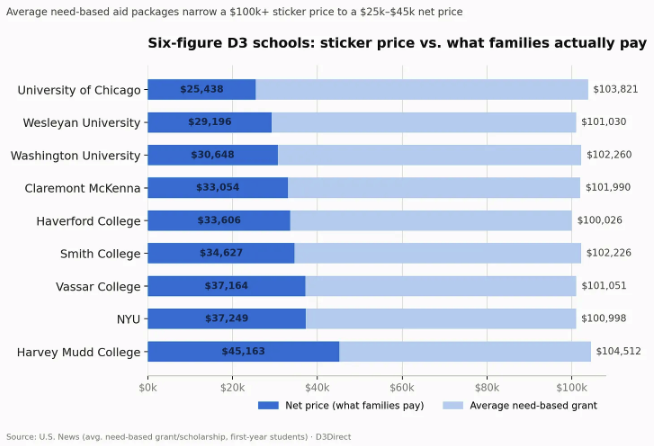
What families actually pay after aid at the most expensive D3 schools.
The average need-based grant across all nine schools is roughly $67,000 a year — reducing the sticker price by about two-thirds for students who qualify.
Do all of these schools meet full financial need?
Yes. All nine schools on this list — University of Chicago, WashU, Smith, Claremont McKenna, Vassar, Wesleyan, NYU, Haverford, and Harvey Mudd — state that they meet 100% of a student’s demonstrated financial need once admitted and aided. That means a family that qualifies for aid isn’t left with an unfunded gap the way they might be at many other private colleges.
What percentage of students actually receive this aid?
This is the number families overlook, and it varies more than the award amounts do:
Highest share of aided students: Vassar (61%), Smith (60%)
Lowest share of aided students: NYU (29%), University of Chicago (33%)
A school can be extremely generous and only reach a minority of its class. NYU’s average award ($63,749) is close to Vassar’s ($63,887), but Vassar extends aid to twice the share of its incoming class. Sticker price and average award tell you what’s possible. The percentage of students aided tells you how likely it is for a specific family.
Here’s an interesting podcast that tries to explain why Vassar gives so much in aid, while others like Bowdoin, focus on other priorities.
Is merit aid different from need-based aid at these schools?
Yes, and it’s far smaller and rarer. At most of these schools, merit (non-need) scholarships go to a small fraction of admits and are meaningfully lower than need-based awards:
Washington University: ~$42,765 average merit award, but only ~2% of first-year admits receive it
Claremont McKenna: ~$12,534 average merit award
NYU: ~$23,737 average merit award
For the large majority of families, need-based aid, not merit aid, and certainly not athletic scholarships, is the mechanism that makes these schools affordable.
Want to make college more affordable? Subscribe to our free weekly series, Scholarship Sunday, to get scholarships and resources delivered directly to your inbox for free every weekend.
What does this mean for D3 recruits and their families?
Don’t rule out a school based on the sticker price alone. A $100K+ total cost is the number very few students actually pay.
Ask about the percentage of students receiving aid, not just the average award. A generous average package means little if only 3 in 10 students get one.
Run each school’s Net Price Calculator before assuming any of the numbers above apply to your family. These are institution-wide averages, not personalized estimates so double check based on your numbers.
Remember D3 has no athletic scholarships. Full stop. Any financial support a recruited D3 athlete receives is the same need-based or merit aid available to their non-athlete classmates. Recruiting can open the admissions door; it does not change the financial aid formula.
Thanks for reading today’s post. Reach out on social media and let us know what we can do better next time.
Here’s where we got our data from if you want to learn more.
Data: U.S. News & World Report (average need-based scholarship/grant, first-year students, most recent Common Data Set filings); sticker price data via The Princeton Review / CNBC, 2026-27 academic year.
This piece is intended for general informational purposes. Each family’s financial aid eligibility depends on individual circumstances — use each school’s Net Price Calculator for a personalized estimate.